








 DEVELOPING YOUR TEAM
What separates your best team from your worst? These 6 capabilities.
by Jill BarthHR Executive
Most HR leaders know what high-performing teams look like. They adapt quickly, learn from each other and deliver consistent results. But knowing what excellence looks like and understanding why most teams fall short are two different challenges.
New research from Deloitte’s Center for Integrated Research surveyed nearly 1,400 professionals to identify what separates high-performing teams from the pack.
Spending on the wrong things?
The findings reveal that many organizations are funneling resources into less impactful areas while starving their teams of the capabilities that actually drive sustained performance.
Deloitte’s 2026 Tech Trends report found that 93% of AI expenditures go toward tech infrastructure, with just 7% earmarked for people-related issues. This imbalance also shows up in learning priorities. Only 42% of high-performing team members report receiving equal training on technology and human skills, compared to just 15% for other teams.
So, what lessons are they missing? These could be more difficult to teach. Deloitte identified six human capacities that differentiate high performers: curiosity, emotional and social intelligence, divergent thinking, informed agility, resilience and connected teaming.
“As the half-life of skills – particularly technical skills – continues to decline, and as human collaboration with artificial intelligence continues to grow, these capabilities may become even more important in ensuring that individual workers and organizations are resilient to changes in the external landscape,” the report states.
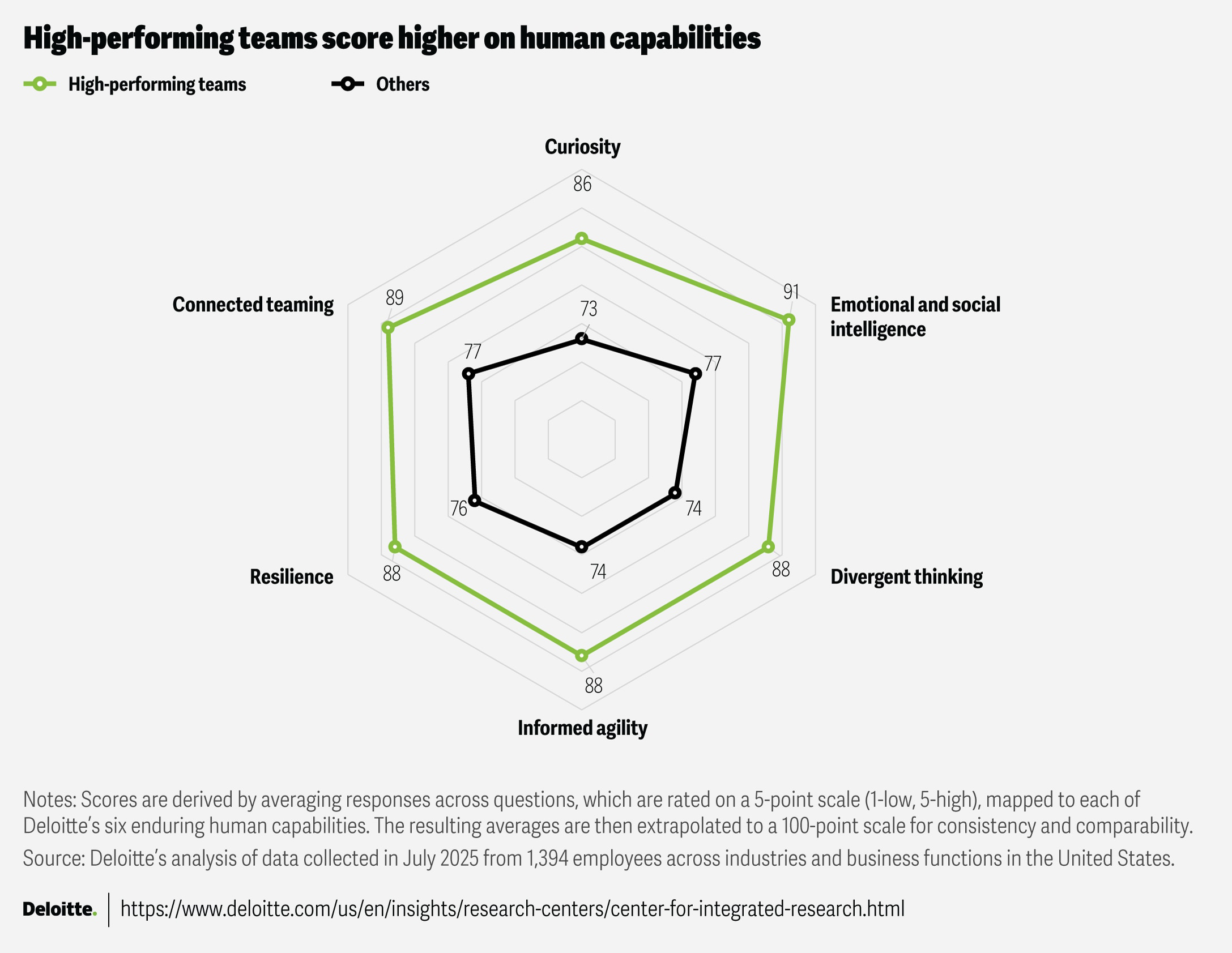
Where high-performing teams pull ahead
High-performing teams differ sharply from others across nearly every measure of workplace culture. Members are more than twice as likely to report mutual respect, trust and support from colleagues. They also show stronger inclusion and a much greater emphasis on diverse skills, experiences and viewpoints – both in hiring and in decision-making.
The research also shows high-performing teams are 2.5 times as likely to quickly change direction, support each other through change and explore unfamiliar ideas by continuously learning new skills. This informed agility appears critical in navigating rapid technological change.
The failure problem
Even high-performing teams struggle with creating safe spaces for experimentation. Only 50% of surveyed high performers say their team learns from failures without overemphasizing fault-finding. In underperforming teams, that number drops to 21%.
This matters because the research found that fewer than a third of respondents on high-performing teams said their team engages in exploratory behaviour, despite showing strong curiosity and resilience. Without psychological safety to try new approaches, according to Deloitte, teams can’t develop the adaptive capabilities needed for an AI-driven future.
High-performing teams also show different patterns in how they work with AI. Seventy-eight percent use AI tools in their work, compared to 54% of other teams. More importantly, 36% rate their experience working with AI as “very high quality” in supporting core work, versus just 18% of others.
The research suggests this advantage stems from stronger human capabilities, not superior technical skills. High-performing team members were also significantly more likely to report very high-quality experiences working with human colleagues on the same tasks, indicating they’ve developed clearer frameworks for integrating new technology into existing workflows.
Rethinking development
By investing in enduring human capabilities, leaders can create conditions where innovation and value creation flourish.
The research points toward a shift in how organizations should think about team development. Sixty-three percent of survey respondents say human skills will increase in importance over the next two years, even as technology continues to advance. Yet, training investments don’t reflect this reality.
High-performing teams also create stronger cultures of formal and informal learning, write the researchers. They’re significantly more likely to promote apprenticeship and to approach work as an opportunity to learn from each other. This focus on continuous learning creates a compounding advantage over time.
“By investing in enduring human capabilities, leaders can create conditions where innovation and value creation flourish,” researchers write. “In doing so, they may help ensure that their teams are not just responsive to change, but capable of shaping it in ways that deliver long-term impact for both the workforce and the organization.”
About the Author
Jill Barth is HR Tech Editor of HR Executive. She is an award-winning journalist with bylines in Forbes, USA Today and other international publications. With a background in communications, media, B2B ecommerce and the workplace, she also served as a consultant for nearly a decade.
Contents of this article remain the property of the author and/or publisher.